Implementation
STEM Bursary & Intervention Fund
This comprehensive proposal plan establishes a structured framework for securing and retaining corporate donors for the Beacon of Change (BoC) Foundation STEM & Education Bursary Fund. It integrates economic feasibility validation, institutional partnership models, and empirical mapping across shopping malls and retail footprint nodes.
Core Value Proposition
The Beacon of Change STEM Bursary & Intervention Fund bridges the gap between high-yield retail/energy commerce in township markets and local youth empowerment. Corporate donors obtain maximum B-BBEE scorecard optimisation (Socio-Economic Development), Section 18A tax deductions, and brand alignment in the core consumer hubs where they generate revenue.
Strategic Donor Mapping and Personas
Donor Selection Centres on businesses that extract commercial value from township footprints (e.g., Soweto Retail centres like Eyethu Mall, Maponya mall and Jabulani Mall, along with commuter fuel spaces) and have an imperative to reinvest locally.
1. The Energy & Fuel Retailer (“The Precinct Anchor”)
- Target Entities: Engen, Shell, Astron Energy, Elegant Group.
- Commercial Footprint: High-density service stations on major township arteries (e.g., Chris Hani Road, Soweto Highway).
- Motivation: B-BBEE Transformation, Petroleum Charter compliance, license-to-operate in local communities, and localised brand equity.
- Value Pitch: “Fuelling the local youth into STEM fields – directly converting every litre sold in Soweto into higher education bursaries for local matriculants”.
2. The FMCG & Retail Supermarket Giant (“The Household Partner”)
- Target Entities: Shoprite/Checkers, PicknPay, SPAR, boxer Superstores, Cambridge Food.
- Commercial Footprint: Anchor tenants in township malls and standalone shopping complexes.
- Motivation: B-BBEE SED points, consumer goodwill, long-term talent pipeline for retail technology, supply chain, and logistics management.
- Value Pitch: “Investing in the households that support your tills – funding STEM degrees that build the future workforce and increase regional household income.”
3. The Property & Mall Holdings Group (“The Infrastructure Landlord”)
- Target entities: Fortress Real Estate, Resilient REIT, Vukile Property Fund, Dipula Income Fund.
- Commerical Footprint: Property owners of regional malls in townships (Maponya Mall, Jabulani Mall, Eyethu Mall, Bara Mall).
- Motivation: ESG compliance, local economic stability, crime reduction around retail nodes, and tenant-community alignment.
- Value Pitch: “Converting commercial real estate footprint into a visible hub of community upliftment and youth skill-building.”
4. Financial Institutions & DFIs (“The Growth Engine”)
- Target Entities: DBSA (already aligned), Standard Bank, Nedbank, ABSA, FirstRand, Capitec.
- Commercial Footprint: Branch networks, ATM corridors, and digital banking ecosystems.
- Motivation: Enterprise & Supplier Development (ESD), financial inclusion, and filling the STEM skills gap in financial engineering and data analytics.
- Value Pitch: “Building high-value human capital to drive South Africa’s digital and industrial economy.”
Phased Execution Roadmap
Phase 1: Foundation, Economic Feasibility & Soweto Pilot (Months 1-6)
- Step1.1: Database Mapping & Scoping (UCT IPA Partnership): Conduct spatial mapping of malls, fuel stations, and corporate footprints in Soweto to pinpoint high-potential contributors.
- Step 1.2: Model Validation & Governance (Dr. F. Mateko Framework): Perform independent economic feasibility testing, risk assessment, and draft an investor-ready endowment/reserve architecture.
- Step 1.3: School & Learner Selection: Execute joint selection with the Gauteng Department of Education for high-density Soweto clusters (e.g., Mofolo, Jabulani) using established criteria.
- Step 1.4: Delivery Kickoff: Initiate Track 1 (Saturday/Holiday STEM tuition) and Track 2 (Grades R-9 teacher support workshops) with technical partners (JB Education & Sangari).
Phase 2: Coastal Expansion (Cape Town & Durban) (Months 7-18)
- Step 2.1: Data Replicability: Deploy the UCT IPA mapping methodology to Kayelitsha/Mitchells Plain (Cape Town) and Umlazi/Inanda (Durban).
- Step 2.2: Anchor Corporate Pitching: Approach regional fuel brand managers and REIT mall owners operating in Western Cape and KZN retail nodes.
- Step 2.3: Provincial Education Endorsement: Secure MOU agreements with the Western Cape and KwaZulu-Natal Department of Education modelled on the Eastern Cape framework.
Phase 3: Pan-African Strategic Scale (Months 19-36)
- Step 3.1: Strategic Framework Agreement: Operationalise the strategic collaboration model with the PLO Lumamba Foundation to enter East African corridors (e.g., Kenya) without taking on operational liability.
- Step 3.2: Multi-National Corporate Funding: Pitch pan-African energy and retail entities for multi-jursidiction bursary allocations.
Donor Pitch & Retention Strategy
To secure initial commitments and achieve long-term donor retention, BoC provides explicit strategic incentives:
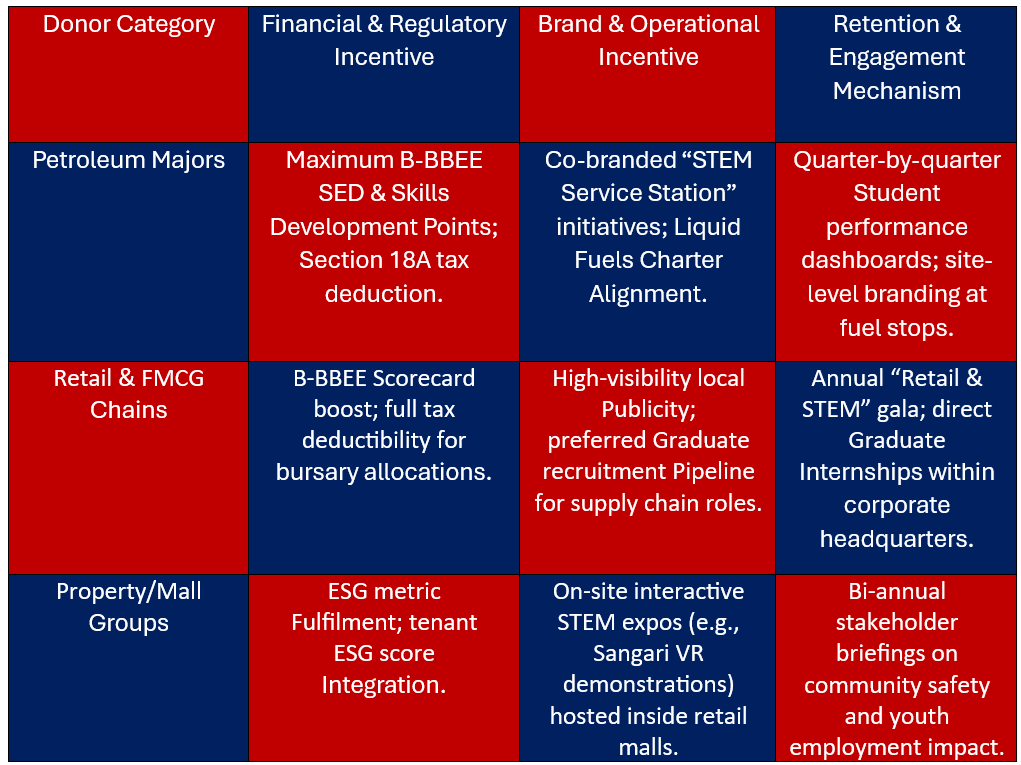
Key Retention Pillars
1. Verifiable Impact Reporting: Monthly attendance, interim summative testing and moderated academic progression metrics delivered to corporate CSI boards.
2. Ring-Fenced Bursary Tracking: Transparency over every Rand spent – attaching specific students directly to named corporate sponsors.
3. Graduate Pipeline Conversion: Offering sponsors first-right-of-refusal for internships, learnerships, and entry-level technical placements for bursary recipients.
Structural alignment & Budget Integration
The project integrates expert validation and operational delivery partners directly into its strategic framework:
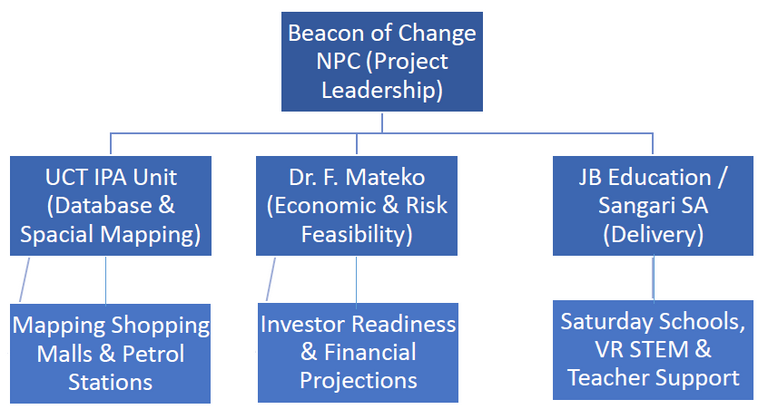
- Spatial Scoping (UCT IPA): Budgeted at R150,000 for database scoping across malls, fuel outlets, and major corporate footprints.
- Economic Validation (Dr. F. Mateko): 110 total structured hours (R1,850/hr) covering independent validation, sustainable funding architecture, and investor-readiness frameworks.
- Education & Tech (JB Education & Sangari): Curriculum-mapped materials, calculators, textbooks, and interactive VR technology.
Head of Fundraising Operational Leadership & Committee Integration Strategy
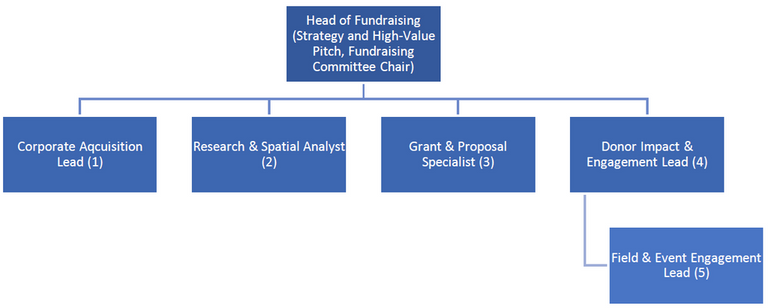
To execute the proposal strategy seamlessly, the Head of Fundraising leads a dedicated 5-person unit alongside a high-level Fundraising Steering Committee. This structure ensures end-to-end accountability, from spatial donor intelligence to corporate deal closure and stewardship.
Fundraising Department Team Structure (Team of 5)
Head of Fundraising: Role Profile, Mandate & Key Performance Indicators (KPIs)
As the Head of Fundraising for the Beacon of Change (BoC) Foundation, the individual serves as the chief revenue strategist, fundraising deal-closer, and leader of both the operational fundraising teams and the Fundraising Steering Committee. You bridge a high-level corporate social investment (CSI), B-BBEE transformation agendas, and ground-level STEM educational delivery.
1. Executive Mandate & Core Responsibilities
Strategic Leadership & Revenue Growth
- Fundraising Strategic Execution: Drive the end-to-end execution of the multi-phase fundraising roadmap (Soweto Pilot to Regional and Continental Scale).
- High-Value Deal Closure: Personally lead pitching and negotiations for major corporate anchor prospects (Petroleum Majors, FMCG Supermarkets, and Property REITs).
- Financial Architecture Integration: Align corporate allocations with Dr. Mateko’s economic feasibility, reserve building, and risk mitigation frameworks.
Operations & Team Management
- Team Leadership: Direct and mentor the 5-person fundraising team (Acquisition, Research, Grants, Stewardship, and Field Operations) to ensure pipeline velocity and goal alignment.
- Spatial & Data Utilisation: Guide the integration of UCT IPA spatial mapping data to build targeted corporate value propositions based on retail footprint nodes.
- Resource & Budget Management: Oversee the departmental operating budget, ensuring optimal ROI on fundraising expenditure.
Committee & Executive Governance
- Steering Committee Leadership: Chair the BoC Fundraising Steering Committee, establishing agendas, leveraging board networks, and presenting performance reports to the Board of Trustees.
- Cross-Functional Collaboration: Partner with academic delivery leaders (JB Education, Sangari SA) and research bodies (UCT IPA) to ensure proposal promises translate into variable field metrics.
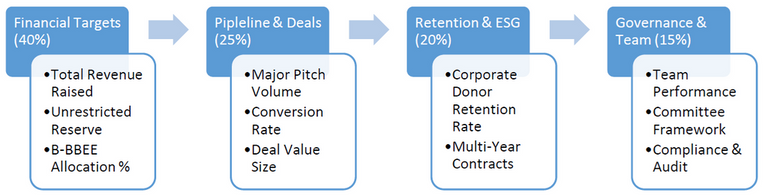
2. Key Performance Indicators (KPIs)
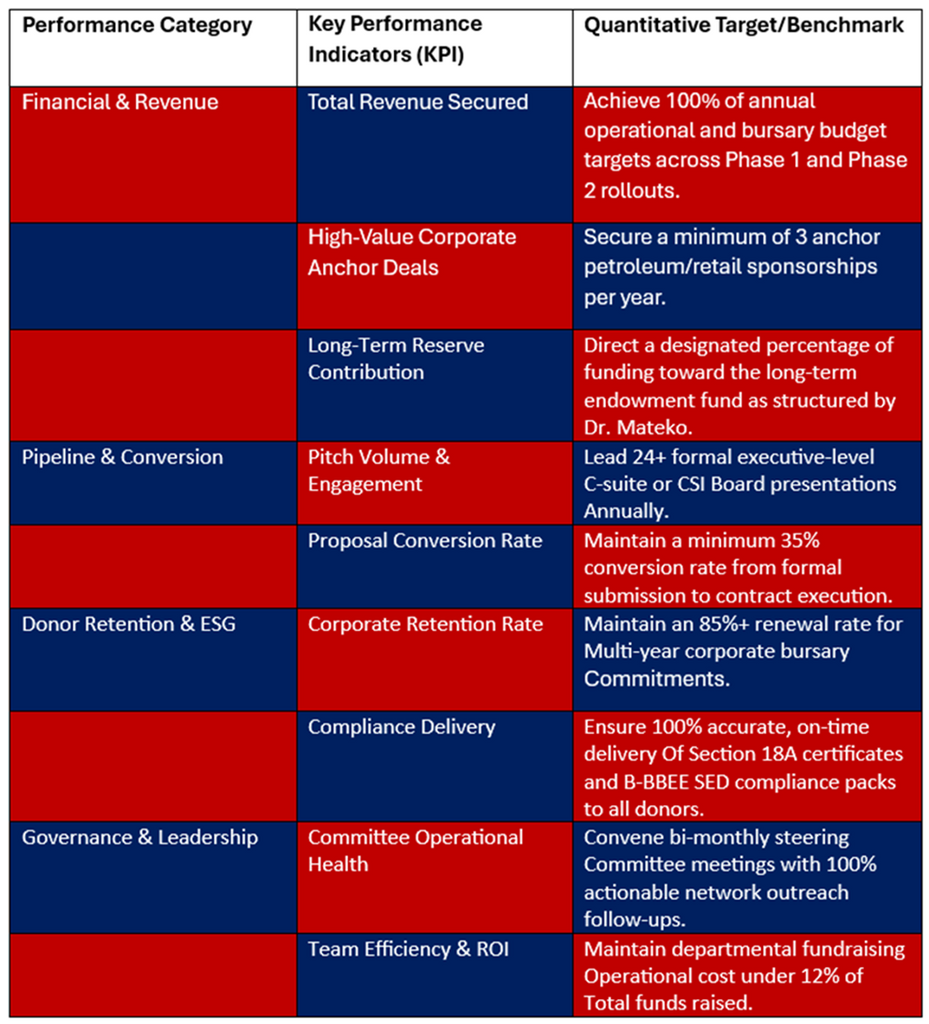
The performance of the Head of Fundraising is evaluated across revenue target achievement, donor pipeline health, team leadership, and strategic governance:
3. Weekly Monthly Framework for the Head of Fundraising
Weekly Framework
- Monday Strategy & Pipeline Review: Review top-tier prospects with the Corporate Acquisition Lead and Spatial Analyst.
- Mid-Week Executive Pitches: Lead high-stakes presentations to corporate CSI heads, social transformation managers, and REIT executives.
- Friday Progress Sync: Review grant draft submissions and audit upcoming compliance requirements with the Grant Specialist.
Monthly & Quarterly Framework
- Monthly: Present pipeline analytics, conversion metrics, and revenue projections to the BoC Executive Director and Board.
- Bi-Monthly: Chair the Fundraising Steering Committee meeting to review strategic obstacles, open C-suite doors, and evaluate donor pipeline health.
- Quarterly: Conduct donor stewardship check-ins alongside the Stewardship Lead, presenting academic impact dashboards sourced from delivery partners.
Fundraising Team: Role Profile, Mandate & Key Performance Indicators (KPIs)
1. Corporate Acquisition Lead (Energy & Retail Specialist)
- Core Role: Frontline deal-maker responsible for securing face-to-face engagements with petroleum majors (e.g., Engen, Shell, Astron Energy) and retail REITs (e.g., Fortress, Resilient).
- Primary KPI: Unlocking B-BBEE SED/Skills Development corporate allocations and closing mutli-year bursary commitments.
2. Research and Spatial Intelligence Analyst
- Core Role: Works directly with UCT IPA spatial datasets to map retail nodes, footfall patterns, and commercial service stations against local school clusters.
- Primary KPI: Building tailored donor dossiers verifying exact corporate revenue footprints within target pilot zones (e.g., Soweto).
3. Grant Writing & Compliance Specialist
- Core Role: Drafts bespoke pitch decks, handles Section 18A tax certificate compliance, and structures corporate proposals incorporating Dr. Mateko’s economic feasibility and risk framework.
- Primary KPI: Proposal conversion rate and 100% audit/regulatory compliance on financial submissions.
4. Donor Impact & Stewardship Lead
- Core Role: Manages ongoing corporate relationships, ensuring sponsors receive student academic progression reports, attendance metrics, and ESG compliance data.
- Primary KPI: Corporate donor retention rate and multi-year contract renewals.
5. Field Operations & Events Coordinator
- Core Role: Coordinates on-site retail activations, shopping mall STEM showcases (with Sangari SA Technology), and community launch events in high-density township nodes.
- Primary KPI: Execution of brand-aligned field events and local stakeholder engagement.
Operational Workflow & Execution Framework
To ensure pitch delivery and contract fulfilment, the team operates on a strict weekly and monthly framework:
- Weekly Pipeline Review (Mondays): Review prospect conversion, pipeline velocity, and spatial report status for upcoming petroleum and REIT pitches.
- Bi-weekly Pitch Sprint: Conduct 4-6 high-level presentations to prospective corporate CSI and B-BBEE committee heads.
- Monthly Impact Sync: Reconcile corporate funds with JB education and Sangari delivery milestones to verify student metrics before sending investor updates.
Governance: The BoC Fundraising Steering Committee
The Fundraising Steering Committee serves as the executive oversight body, providing high-level access, governance, and deal-closing leverage.
Committee Composition
- Chairperson: Head of Fundraising
- Executive members: BoC Executive Director (Mr. Majezi), Financial Director
- External Advisory members: Dr. Mateko (Feasibility & Governance Advisor), UCT IPA Representative (Research Partner), Petroleum/Retail industry CSR Advisor.
Primary Functions & Mandate
1. Strategic Leverage & Network Unlocking: Open doors to C-suite executives at energy majors, financial institutions, and retail funds.
2. Governance & Risk Oversight: Review all corporate sponsorship contracts and ensure alignment with Dr. Mateko’s economic validation model.
3. Approval of high-value Proposals: Sign-off on multi-million Rand proposal before final submissions to corporate boards.
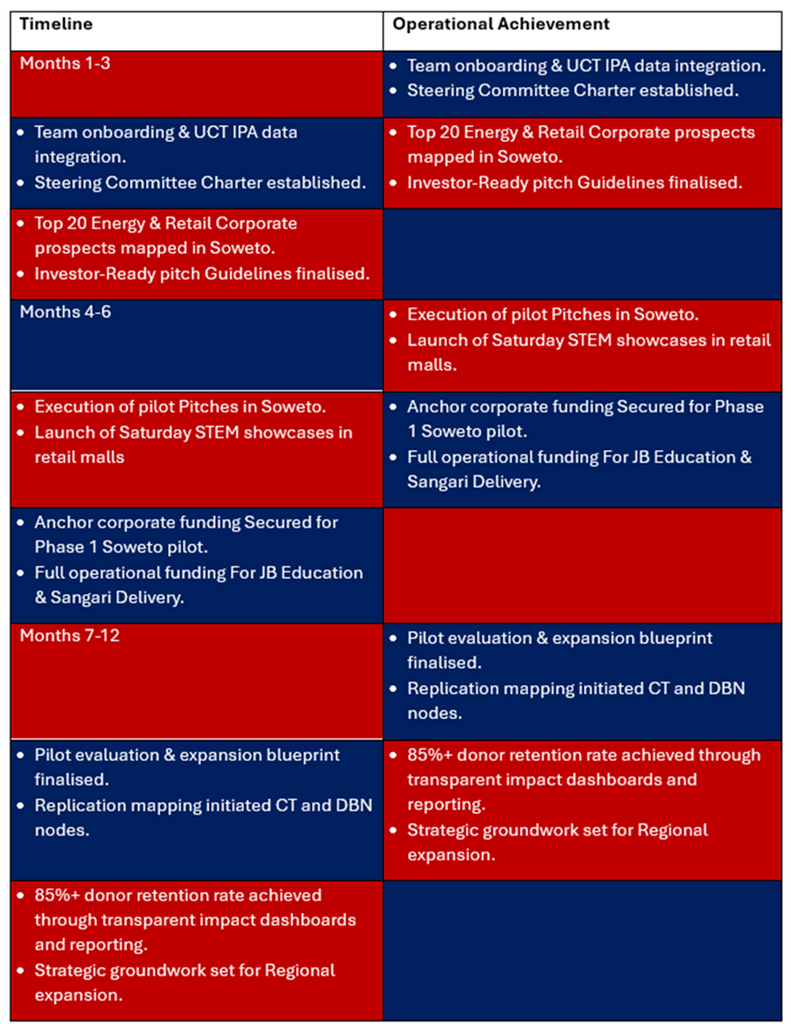
Expected Strategic Achievements & Key Milestones
Head of Fundraising: First 90-Day Execution Plan
Month 1: Systems Setup, Spatial Data & Committee Activation
- Week 1-2: Onboard the 5-person fundraising team; configure the CRM pipeline stages and data integration protocols.
- Week 3: Ingest UCT IPA spatial mapping data to build detailed corporate target profiles across Soweto retail nodes.
- Week 4: Convene the inaugural Fundraising Steering Committee meeting; finalise the terms of reference and assign network outreach leads.
Month 2: Targeted Outreach & Corporate Pitching Sprints
- Week 5-6: Launch targeted pitch campaigns aimed at petroleum majors and property REITs operating in high-density township nodes.
- Week 7-8: Lead C-Suite presentations for top-tier corporate prospects; demonstrate value alignment via B-BBEE scorecard optimisation and Section 18A tax benefits.
Month 3: Deal closure, Pilot Execution & First Review
- Week 9-10: Finalise anchor sponsorship agreements for the Phase 1 Soweto Pilot; issue compliance packs and Section 18A certificates.
- Week 11: Reconcile initial corporate funding allocations with JB Education and Sangari delivery schedules for weekend STEM tuition.
- Week 12: Present the First Quarter Revenue & Impact Dashboard (Reporting) to the BoC Executive Board and Steering Committee.


